
Amina grew up in a small community on the outskirts of Abuja. Her parents were petty traders who believed strongly in education, even though they struggled to make ends meet. Like many children in her area, Amina attended a public primary school funded under the government’s basic education scheme.
At first, she was excited. She loved reading and dreamed of becoming a teacher. But the reality of her school slowly crushed that dream.
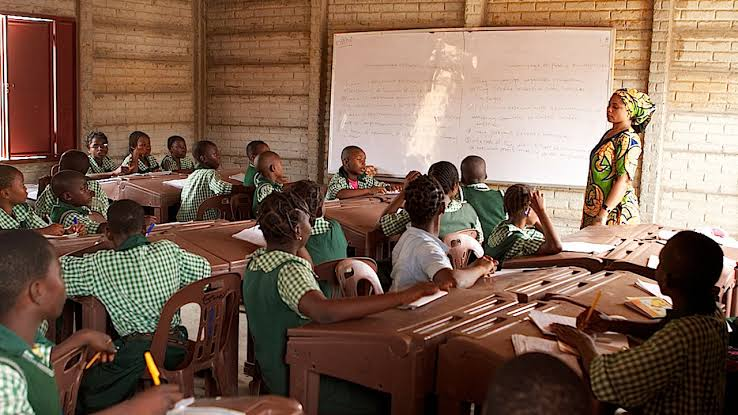
The classrooms were overcrowded, sometimes over 80 pupils in one room. There weren’t enough desks, so Amina often sat on the bare floor. During the rainy season, lessons would have to stop because the roof leaked badly. Their textbooks were outdated, and sometimes five pupils had to share one book.
Her teachers tried, but many were frequently absent. Some hadn’t been paid for months, and others simply gave up. There was no proper monitoring, no intervention—despite funds reportedly allocated for basic education through UBEC.
By the time Amina reached Primary 5, she could barely read fluently. Not because she wasn’t intelligent, but because the system had failed her.
Her biggest struggle came during the transition to junior secondary school. She couldn’t pass the entrance assessment. The foundation she needed was never properly built.
Ashamed and discouraged, Amina dropped out shortly after. She began helping her mother full-time in the market.
Amina’s struggle wasn’t just poverty—it was being failed by a broken system.
Her story reflects a deeper issue: when education funding is neglected or mismanaged, it doesn’t just affect infrastructure, it quietly destroys potential.
Nigeria’s education sector is facing a contradiction that is as troubling as it is revealing: while millions of children remain out of school and public schools deteriorate, billions of naira allocated for basic education lie unused. At the center of this is the Universal Basic Education Commission (UBEC) funding framework—an intervention designed to strengthen primary and junior secondary education, yet increasingly compromised by governmental neglect and systemic inefficiencies.
A System Designed to Work—But Failing in Practice
The UBEC funding model is established on shared responsibility between the federal and state governments. The federal government contributes funds annually—drawn partly from it’s consolidated revenue—while states are required to provide a 50% counterpart contribution to access these grants..
In theory, this ensures accountability and commitment. In practice, it has become a major bottleneck. As of March 2026, over ₦97 billion in UBEC funds remained unused because many state governments failed to meet this requirement.
This failure is not marginal, it’s systemic. At least 21 states and the Federal Capital Territory have been unable or unwilling to draw from these funds, leaving critical educational interventions stalled.
The Scale of Nigeria’s Education Crisis
The consequences of this neglect are magnified by the scale of Nigeria’s education crisis. The country currently has approximately 18.5 million out-of-school children—the highest number globally.
This statistic is not merely a number; it represents a generation at risk. Poverty, insecurity, and cultural barriers already hinder access to education, but weak governance and poor funding utilization deepen the crisis.
Education experts warn that without urgent investment, Nigeria faces a “generational catastrophe,” with long-term implications for economic development, national security, and social cohesion.
Governance Failure and Misplaced Priorities
The persistent failure to access UBEC funds highlights a deeper governance problem. Analysts argue that the issue is not always a lack of resources but a lack of political will and prioritization. Many of the defaulting states have the fiscal capacity to meet counterpart funding requirements but choose not to.
This suggests that education is often deprioritized in favor of other expenditures—political projects, recurrent spending, and administrative costs. As one analyst bluntly put it, “this is not about a lack of money… the issue here is priority.”
Even more concerning is that, in some cases, funds that are eventually accessed are not effectively utilized, leading to poor infrastructure, inadequate teaching materials, and substandard learning environments.
Structural Weaknesses in the UBEC Framework
While state-level neglect is a major factor, the UBEC model itself is not without flaws. The counterpart funding requirement—though designed to ensure ownership—can inadvertently exclude states with weak fiscal capacity or poor budget planning.
Research also points to broader structural issues: Nigeria consistently falls short of recommended education budget allocations, and financial accountability mechanisms remain weak.
Thus, the problem is twofold: a flawed implementation structure and a governance culture that does not prioritize education as a fundamental right.
Human Cost and National Implications
The human cost of this neglect is staggering. Millions of children are denied access to basic education, trapping them in cycles of poverty and vulnerability. Experts warn that out-of-school children are more susceptible to exploitation, crime, and radicalization—making the education crisis not just a social issue, but a security threat.
In the long term, the consequences extend to economic stagnation. A poorly educated population undermines productivity, innovation, and national competitiveness. Simply put, neglecting education today mortgages the country’s future.
The Way Forward??
Addressing this crisis requires urgent and coordinated action:
Enforcement of accountability: The federal government must enforce compliance, possibly through sanctions or incentives for states that fail to access funds.
Reform of the funding model: Revisiting the counterpart funding requirement could make the system more inclusive and effective.
Transparency and monitoring: Stronger oversight mechanisms are needed to ensure funds are properly utilized.
Political re-prioritization: Education must be treated not as a discretionary expense but as a national emergency.
The neglect of UBEC funding in Nigeria is not merely an administrative lapse, it is a reflection of deeper systemic failures in governance and priority-setting. At a time when the nation faces an unprecedented education crisis, leaving billions of naira unused is both indefensible and dangerous.
If Nigeria is to secure its future, it must begin by investing, fully and responsibly in it’s most valuable resource: it’s children.
In recent years, Nigeria has faced a severe education crisis, marked by underfunded schools, a lack of qualified teachers, and a growing number of students unable to access quality education. At the heart of this crisis lies a critical issue: the Nigerian government’s continued neglect of the Universal Basic Education (UBEC) funding. Despite the urgent need for investment in education, the government has failed to adequately allocate resources to the UBEC program, exacerbating the challenges faced by students and educators alike.